

Conceptual Framework: Definition, Construction, and Examples

A conceptual framework is a structured way of showing how the key concepts in your study relate to each other. It helps you define what you are studying, explain why it matters, and justify how you will investigate it. In this post, you’ll find a clear definition of a conceptual framework, a practical step-by-step method for building one, and several examples you can adapt for your own research.
Table of contents
- What is a conceptual framework?
- Why conceptual frameworks matter
- How to construct a conceptual framework
- Examples of conceptual frameworks
- Frequently asked questions
- Conclusion
What is a conceptual framework?
A conceptual framework is a researcher-created model that defines the main concepts in a study and explains the relationships between them. It is typically grounded in existing theory and literature, and it provides a “map” for how the study will be designed, what data will be collected, and how findings will be interpreted.
Why conceptual frameworks matter
- Clarify the focus of your study by defining key constructs and boundaries.
- Show theoretical grounding by linking your study to relevant literature and concepts.
- Support methodological choices by aligning variables, measures, and data collection with the model.
- Guide analysis and interpretation by providing a logic for what relationships you expect to see.
- Improve coherence in writing by giving your research a clear “through-line”.
How to construct a conceptual framework
- Define your research problem and question
Start by being specific about what you want to explain, explore, or understand. - Identify key concepts and variables
List the central constructs relevant to your topic, then define them clearly (and operationalise them if you will measure them). - Review the literature and select a theoretical lens
Identify theories, models, or frameworks that explain relationships relevant to your question, and decide which ones best fit your aims. - Specify relationships and assumptions
Decide how you believe the concepts are connected (direction, mechanisms, mediators/moderators if relevant), and make your assumptions explicit. - Create a simple visual model
Use a diagram to show the concepts and links between them. Keep it simple: labels should match your writing and your variables. - Refine the framework
Revise the model based on supervisor feedback, feasibility, and whether each element is necessary to answer your question.

Examples of conceptual frameworks
Below are three common examples of established theories/models that can be used as conceptual frameworks. In practice, researchers often adapt these frameworks by selecting only the concepts that are relevant to the research question.
Ecological Systems Theory (EST)
- Key concepts: Microsystem, mesosystem, exosystem, macrosystem, chronosystem.
- Core relationship: Individuals are influenced by multiple environmental systems (family, school, community, culture, historical context).
- Example application: Understanding child development within the context of interacting social environments.
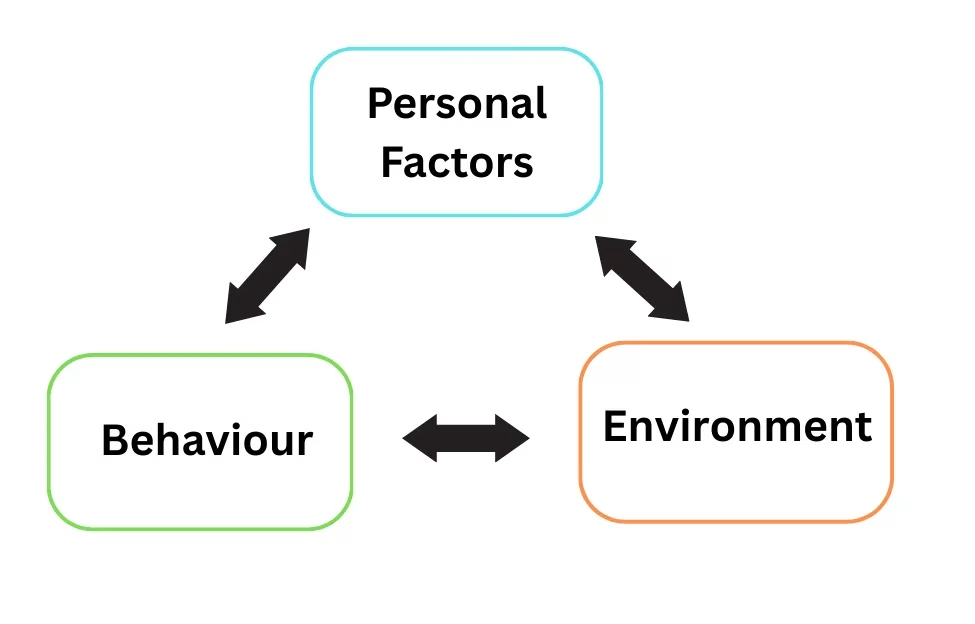
Social Cognitive Theory (SCT)
- Key concepts: Self-efficacy, observational learning, behavioural modelling, outcome expectations.
- Core relationship: Behaviour is shaped by cognition, social learning, and environmental influences.
- Example application: Exploring factors that influence health behaviours and behaviour change.
Technology Acceptance Model (TAM)
- Key concepts: Perceived usefulness, perceived ease of use, attitude, behavioural intention.
- Core relationship: Adoption is influenced by beliefs about usefulness and ease of use, which shape attitudes and intentions.
- Example application: Investigating factors influencing adoption of mobile banking applications.
Frequently asked questions
What is a conceptual framework?
A conceptual framework is a model that defines the key concepts in a study and explains how they are expected to relate to each other.
What is the difference between a theoretical framework and a conceptual framework?
A theoretical framework is based on an established theory, while a conceptual framework is a researcher-developed model that may draw on one or more theories and concepts to fit a specific study.
Where do you include a conceptual framework in a dissertation?
Conceptual frameworks are usually presented in the literature review or methodology chapter, often as a diagram with a short explanation of how it informs the study design and analysis.
How detailed should a conceptual framework be?
It should be as simple as possible while still capturing the key concepts and relationships needed to answer the research question.
Do you need a diagram for a conceptual framework?
A diagram is not always required, but it is often helpful because it makes the concepts and relationships clear and easier to communicate.
Conclusion
A conceptual framework provides a clear and defensible structure for a research project. By defining key concepts, grounding them in the literature, and showing how they connect, researchers can strengthen research design, improve coherence in writing, and interpret findings more effectively.
Need help with your academic work?
We provide professional academic writing support including proofreading, editing, paraphrasing, humanising, and full qualitative data analysis. If you’d like expert help with your dissertation, thesis or research project, you can explore our services below or send us a quick message.


