

The Research Onion: peeling back the layers

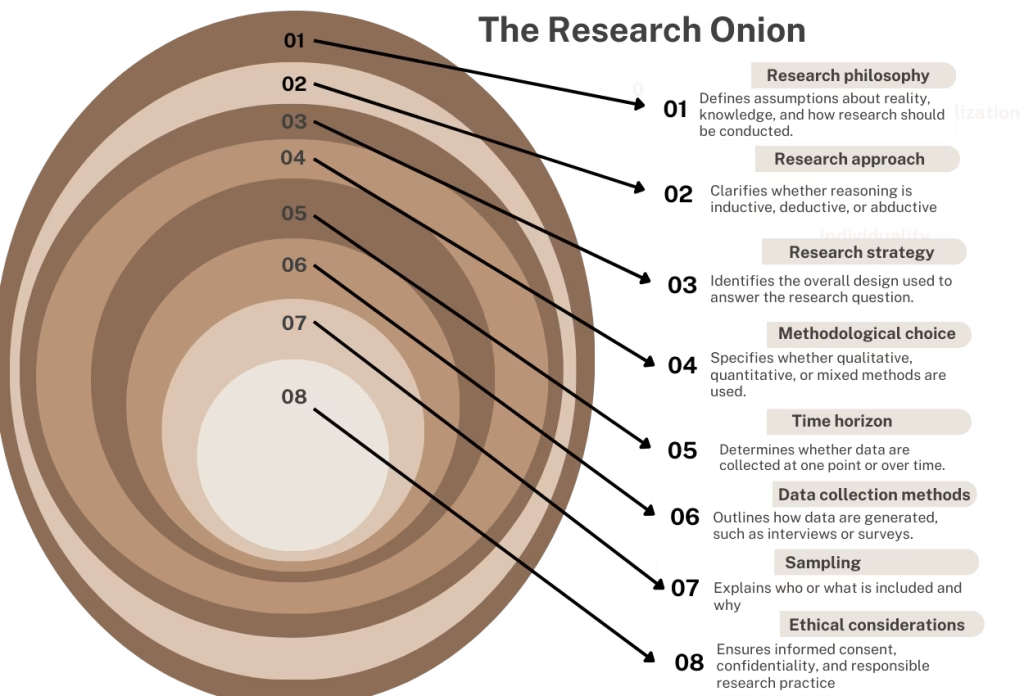
The research onion (Saunders et al.) is a practical framework for building a coherent research design. It helps you move step-by-step from broad philosophical choices to the specific methods you will use to collect and analyse data. In this post, we peel back the layers of the research onion and explain how each layer shapes your overall study.
Table of contents
- What is the research onion?
- Layers of the research onion
- Benefits of the research onion model
- Summary
- Recommended reading
- Frequently asked questions
What is the research onion?
The research onion is a model that visualises the layers of a research study, emphasising how decisions progress from broad philosophical assumptions to specific research methods and techniques. Developed by Mark Saunders, Philip Lewis, and Adrian Thornhill, the model encourages you to make choices systematically, so your research design is cohesive and defensible.
Layers of the research onion
- Philosophical assumptions
The outer layer represents your worldview and guiding assumptions. It includes ontology (the nature of reality), epistemology (the nature of knowledge), and your view of methodology (how knowledge should be produced). - Research approach (paradigm)
Next, you clarify your overall research approach (often described as a paradigm), such as positivism, interpretivism, or pragmatism. This choice influences the kinds of claims you can make and the methods that make sense for your question. - Research strategy
Here you choose the overarching strategy that fits your approach and question. Examples include experiments, surveys, case studies, and action research. - Time horizon
This layer addresses the timeframe of your study. You decide whether your design is cross-sectional (a snapshot at one point in time) or longitudinal (data collected across time). - Data collection methods
Now you select the specific methods you will use to gather data, such as interviews, observations, surveys, or document analysis. The key is alignment with your research questions and design. - Sampling
You decide who or what to include and why. This may involve probability or non-probability sampling, as well as practical decisions about access, sample size, and inclusion criteria. - Data analysis techniques
This layer covers how you will analyse the data you collect. Quantitative studies often use statistical techniques, while qualitative studies may use methods such as thematic analysis or grounded theory. - Ethical considerations
At the centre are ethics: informed consent, confidentiality, data protection, avoidance of harm, and integrity in reporting. Ethics should inform decisions across all layers, not just at the end.

Benefits of the research onion model
- Systematic decision-making
The research onion provides a structured way to make choices at each stage, helping ensure that decisions align with the overall purpose of the study. - Coherence in research design
Working through the layers helps you build a design that is consistent: your methods and analysis make sense given your philosophical assumptions and approach. - Flexibility and adaptability
The framework supports different research questions, disciplines, and constraints. Researchers can adapt methods to context while still maintaining a clear rationale. - Clearer communication
The model helps you explain and justify your design choices to supervisors, examiners, reviewers, or stakeholders.
Frequently asked questions
What is the research onion?
The research onion is a framework (Saunders et al.) that helps you design a coherent study by moving from broad philosophical assumptions to specific research methods, sampling, and analysis choices.
Which layer of the research onion should I start with?
Start with your research question, then work outward-to-inward: clarify your philosophical assumptions and approach first, and only then choose strategy, time horizon, methods, sampling, and analysis.
What is the difference between a research approach and a research strategy?
A research approach (or paradigm) is your overall stance about knowledge and how it should be produced, while a research strategy is the high-level design you use to answer the research question (such as a survey, experiment, or case study).
Can the research onion be used for qualitative and quantitative research?
Yes. The research onion can guide qualitative, quantitative, and mixed methods designs because it focuses on alignment between assumptions, design choices, and the methods used to collect and analyse data.
What are common mistakes when using the research onion?
Common mistakes include choosing methods first without justifying assumptions, mixing incompatible approaches, and listing layers without explaining how each choice fits the research question and aims.
Summary
The research onion is a useful planning tool for designing a coherent study. By considering each layer systematically, you can align your philosophical stance, research approach, strategy, methods, sampling, and analysis in a way that is methodologically sound and easy to justify. If you’re writing a proposal, dissertation, or journal paper, using the research onion can help you explain why your design choices make sense.
Recommended reading

Saunders, M., Thornhill, A., & Lewis, P. (2023). Research Methods for Business Students. Pearson. (Click to view on Amazon #Ad)
Research Methods for Business Students has been fully revised for this ninth edition and continues to be the market-leading textbook in its field, guiding hundreds of thousands of student researchers to success in their research methods modules, research proposals, projects and dissertations. From the creators of “the research onion”.
Need help with your academic work?
We provide professional academic writing support including proofreading, editing, paraphrasing, humanising, and full qualitative data analysis. If you’d like expert help with your dissertation, thesis or research project, you can explore our services below or send us a quick message.


